Toolkit
Getting to Know Kin Caregivers & Involving Them in Program Development
Download This Resource

Before starting a new kin caregiver support program, it’s critical to understand kin caregivers and their families: who they are, their strengths and challenges, and how to involve them in developing your new program. This resource provides background information about kin caregivers and their families, describes program development, and explains how and why to involve kin caregivers in your program development process.
Getting to Know Kin Caregivers and Their Families: Definitions and Demographics
Nationwide, about 2.5 million children are being raised by grandparents, other relatives, or close family friends. Collectively, the relatives and friends who are raising children whose parents cannot are frequently called “kin caregivers.” The families are often called “kinship families,” “grandfamilies,” or “kinship/grandfamilies.”
Kinship/grandfamilies form for a variety of reasons, including parental substance use, incarceration, death, and military deployment. Kinship/grandfamilies who are involved with the child welfare system tend to get more services than those who are not, but for every one child being raised by kin through the foster care system, there are 19 children being raised by kin outside of foster care.
The best available data about kin caregiver demographics is about grandparents who are raising their grandchildren:
- 50 percent of grandparents raising their grandchildren are age 60 or older
- 26 percent of grandparents raising their grandchildren have a disability
- 18 percent of grandparents raising their grandchildren live below the poverty line
- 55 percent of grandparents raising their grandchildren are still in the workforce
Strengths
Research shows that both kin caregivers and children benefit from being in these families. When compared to children raised in non-relative foster care, children in kinship/grandfamilies experience greater safety, stability, and well-being. Kin caregivers report feelings of satisfaction, pride, and meaning in their role.
Unique Challenges
- Many kin caregivers experience challenges enrolling the children in school or making health care decisions for the children because, unlike parents, they don’t have an automatic legal relationship with the children they are raising.
- Kin caregivers frequently receive children into their homes without warning, often following a distressing event (e.g., parental death, incarceration, substance use, etc.).
- Kin caregivers rarely plan for the arrival of children, which can result in challenges with childcare (especially among kin caregivers who are still in the workforce) and finances.
- Older kin caregivers who have downsized their homes or are living in housing where children are not permitted (e.g., senior housing) may face an immediate need to move.
Involving Kin Caregivers in Program Development
By involving [kin caregivers in the program development process], the program can be designed to provide relevant support and resources, leading to more effective outcomes and higher levels of satisfaction and engagement from participants.
Area Agency on Aging Professional
Involving kin caregivers in program development ensures that your program is designed to meet the unique needs of kin caregivers in your community, and it may help with outreach and lead to better outcomes.
- Seek two or more kin caregivers who represent the relevant characteristics of the population you intend to serve.
- If your organization doesn’t have current relationships with kin caregivers, consider forging relationships with organizations in your community that might (e.g., any organization supporting children or families: local daycares, schools, YMCAs, Boys & Girls Clubs, etc.). Check out Generations United’s GrandFacts Fact Sheets for additional ideas.
- Support kin caregivers as you engage them in this work, including by thinking about the potential barriers you or your organization may face in trying to involve kin caregivers in the program development process and trying to plan ahead to come up with solutions.
- Tell kin caregivers how their input/information will be used.
- Prepare kin caregivers to provide input, including by providing technology training (e.g., how to use Zoom), as needed.
- Compensate participants for their time and expertise through stipends/ honoraria, gift cards, or other means. Keep in mind that some kin caregivers receive public benefits that could be jeopardized by compensation, so gift cards or other means may be the best way to compensate them.
- If the kin caregivers you know don’t have time during the day to participate in program development, consider offering opportunities for participation in the evening, on weekends, or via different media, such as questionnaires they can complete as their time allows.
- If the kin caregivers you know need childcare to be able to participate in program development, consider holding your meetings in places where childcare can be provided on-site, or offer opportunities to participate virtually or by phone.
- Write down the goals you hope to achieve by engaging kin caregivers in your program development process. Then, for each goal, identify at least three open-ended questions you’d like caregivers to answer.
- Example: One of your goals might be to ensure that your program/ service is easily accessible by kin caregivers in your community. Therefore, you may wish to ask caregivers about their preferred way of receiving information, the mode of transportation they rely on the most, and their childcare needs.
Program Development
While there are many models for developing social services, this learning community used the simplified model shown below.
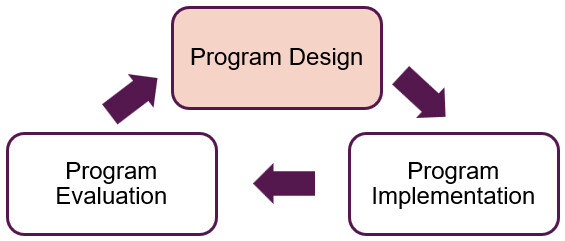
The learning community only covered the first step in this model, Program Design, and focused on the critical sub-steps shown below.
- Understand the strengths and challenges of the target population and your community through a community needs and resource assessment.
- Articulate a value proposition about how your program will address the unmet needs of the target population and develop a logic model defining inputs, activities, outputs, and outcomes.
- Identify potential partners and funding sources.
Other Program Development Models
· Creating a Rural Community Health Program: Where to Begin, by the Rural Health Information Hub
· A Model for Getting Started: How Do We Begin Taking Action in the Community?, by the University of Kansas Community Toolbox
· Toolkit for Tutoring Programs, by the National Student Support Accelerator
Suggested Readings
- Methods and Emerging Strategies to Engage People with Lived Experience, from the U.S. Office of the Assistant Secretary for Planning and Evaluation
- Recruiting Individuals with Lived Experience, from the U.S. Office of the Assistant Secretary for Planning and Evaluation
- Tips to Include Kinship/Grandfamilies in Programmatic Decision-Making, from the Grandfamilies & Kinship Support Network
- What is Lived Experience?, from the U.S. Office of the Assistant Secretary for Planning and Evaluation