Network Impact
The Grandfamilies & Kinship Support Network launched in 2021 with a 5-year cooperative agreement from the U.S. Department of Health and Human Services Administration for Community Living. We exist to help community-based organizations and government agencies in states, Tribes, and territories improve services and supports for grandfamilies and kinship families.
By the Numbers:
We have reached more than 625,000 professionals who support kinship families, since 2021. Specifically, we have:
- Responded to over 1,400 requests for support from all 50 states and several Tribes and territories.
- Supported over 65,000 professionals via presentations, trainings, peer-learning communities, and webinars.
- Published over 160 practical resources.
- Highlighted 35 high-performing kinship programs and practices that others can learn from and replicate.
To learn about our work and its impact since we began, see this brochure and our milestones.
A Snapshot of the Network’s Services & Reach:
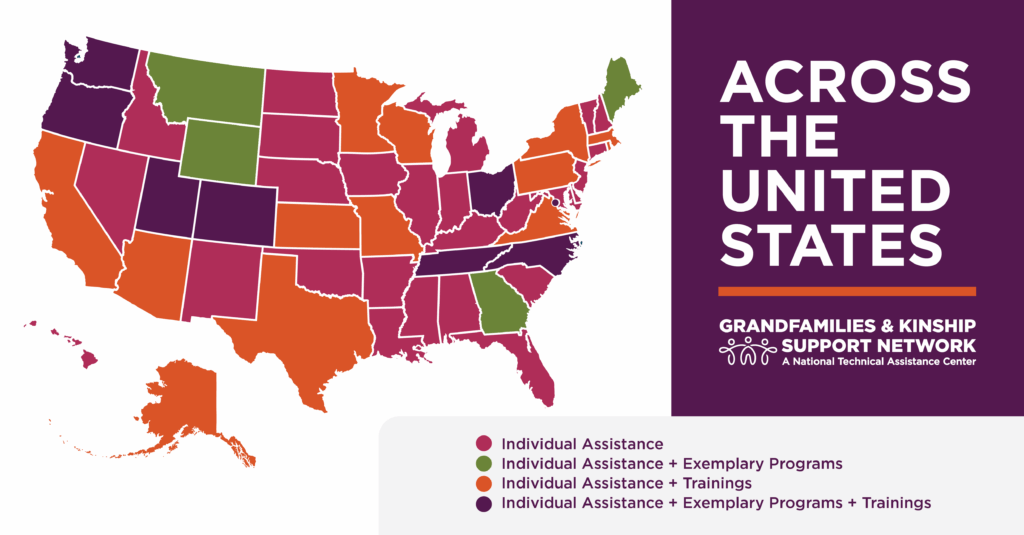
What Others Say About Us:
Alabama
They do for us what we aspire to do for our family resource centers—listening to what we need, pointing us to best practices, and giving us the confidence that our next steps are going to be based on what works.
Joan Witherspoon-Norris, Executive Director, Alabama Network of Family Resource Centers
When the Alabama Network of Family Resource Centers (ANFRC) began recognizing the unique challenges facing kinship families, Executive Director Joan Witherspoon-Norris knew she needed expert guidance. ANFRC had long served multi-generational households, but resources tailored to their needs were scarce. For example, housing instability and barriers to accessing TANF benefits emerged as pressing issues.
The Grandfamilies & Kinship Support Network became an invaluable partner, offering research, resources, and expertise. They facilitated connections to similar organizations in other states and key stakeholders in Alabama that helped ANFRC begin developing more targeted support for these kinship families
“They are the best,” Joan said. “They do for us what we aspire to do for our family resource centers—listening to what we need, pointing us to best practices, and giving us the confidence that our next steps are going to be based on what works.”
From the very start, the Network’s efficiency, expertise, and responsiveness stood out. Gentale Hankins, Director of Program Development, joined the organization in October 2024 to, in part, specifically build their services for kinship families. She drew on her lived experience as a kinship caregiver and her professional background in social work to engage deeply with the Network’s webinars, publications, and workgroups. The Network formed a TANF policy workgroup, which Gentale joined, and it provided her with a broader view of the systemic barriers affecting kinship families across the country and practical strategies for addressing them.
“Anything I could think of—educational resources, grants, policy information—they had it,” Gentale recalled. “I didn’t have to look far to find what I needed to help us collect resources and navigate all these moving parts.” ANFRC could easily adapt resources to fit Alabama’s context, giving local organizations concrete tools to share with families.
Joan emphasized that they are able to better serve kinship families because of the Children’s Trust Fund of Alabama, which provides critical funding and deep knowledge about the prevention of child maltreatment ; and the Network, which provides expertise and connections. “Without them, we simply couldn’t be engaged in this work,” she said.
One of the most impactful moments came when the Network convened a learning collaborative with ANFRC, the Alabama Department of Human Resources (Child Protective Services), and the Children’s Trust Fund. This simple yet intentional connection allowed ANFRC to build a strong relationship with the state’s kinship care division, paving the way for collaboration, trust, and shared learning. “Whatever magic the Network did, it worked,” Joan said. “It changed our trajectory.”
Today, both women credit the Network with accelerating their progress, expanding their vision, and connecting them to peers and models nationwide. “They’re efficient and incredibly knowledgeable. They don’t just send canned emails. Every bit of advice they give is personalized to our needs,” Gentale said. “It’s amazing to work with people who genuinely listen, respond, and help you move forward.”
While ANFRC’s kinship work is still in the early stages, Joan and Gentale see this as the start of a long, intentional journey to better serve Alabama’s kinship families—one they are determined to continue with the guidance of trusted national experts at the Grandfamilies & Kinship Support Network and the support of the Children’s Trust Fund of Alabama.
Alaska
From questions about launching as an independent nonprofit to designing our model, managing referrals, and evaluating the program, the Network could answer absolutely every question I had.
Holly Handler, Co-Founder, Kin Support Program – Haa Yaitx’u Saiani
Holly Handler has been a child welfare attorney, public defender, and supervising attorney for Alaska Legal Services, and she has handled many legal cases under the Indian Child Welfare Act.
In 2023, Holly sought support from the Grandfamilies & Kinship Support Network to help her and her business partners open the Kin Support Program – Haa Yaitx’u Saiani, out of their desire to serve grandparents and other family members struggling to care for young relatives outside the foster care system.
She credits the Network with helping her bring her idea to reality in 2023. She shared, “From questions about launching as an independent nonprofit to designing our model, managing referrals, and evaluating the program, the Network could answer absolutely every question I had. They put me in touch with other small, independent programs like the one we were hoping to build so we could leverage their best practices. I had an extraordinary counseling session with one of the subject-matter experts Dr. Angelique Day who helped us begin to design our program evaluation.”
With the Network’s dedicated, personal support, as well as its resources via newsletters and webinars, Holly’s team was able to open the Program’s doors in July 2024. Since that time, the Program’s two family specialists, kin attorney, and contracted parent attorney have together served 62 families.
In the near future, Holly hopes to see Alaska fund an array of programs and services that help keep kids with their kin, as well as finalize a state prevention plan, as Alaska is one of four in the nation that does not yet have one. She’d like to see the Kin Support Program be a best-in-class example of the power of offering preventative services and helping kids stay with kin, as research shows when children cannot stay with their parents, they have the best life outcomes if they are able to stay with relatives (instead of non-kin).
Colorado
The Network is helping people understand the challenges that kinship caregivers have, and what role they can play in that healing process.
Gail Engel, Subject Matter Expert, Grandfamilies & Kinship Support Network, Founder/Executive Director, Grand Family Coalition
Idaho
They are the nation’s leading experts on kinship. Having them come to Idaho and help support our state—that in itself is huge. People in our state notice that attention from the national level. It helps bring people to the table.
Jen Haddad, Idaho Department of Health and Welfare
From Project to Policy: Idaho Launches Nation’s First Statewide Kinship Plan
When Jen Haddad of the Idaho Department of Health and Welfare’s Division of Family and Community Partnerships first learned about the Grandfamilies & Kinship Support Network’s Bridging Systems initiative, she saw a chance to bring Idaho’s vision for kinship families to life.
The Division’s work sits at the preventative edge of child welfare: Jen and her team run the 211 Idaho CareLine and a resource and service navigation program designed to keep children out of the foster care system. Kinship families are central to that mission.
Idaho has the highest rate of incarcerated women in the nation per capita, a data point that drives the urgency of better support for them. When a mother is incarcerated, her children often go to a relative. Layered on top of that is Idaho’s geography: a mix of mid-size cities and a vast rural population, where families can be hard to reach and resources hard to find.
Building a Coalition and a New Kind of Partnership
When her team saw the Bridging Systems opportunity, they assembled a coalition of three lead partner agencies: the Department of Health and Welfare, the Idaho Department of Correction, and the Idaho Caregiver Alliance—a Boise State University-based organization with deep expertise in kinship and caregiving advocacy across the lifespan.
They applied, were selected in March 2024, and over the next two years, the Grandfamilies & Kinship Support Network became a genuine partner. Monthly calls with the full Idaho group, twice-yearly in-person meetings, and frequent mid-week check-ins gave Jen access to a level of technical support she’d never experienced before. “I’ve received technical assistance in other roles, but never with this level of intensity or this amount of resources,” she said. “It feels so holistic.”
The breadth of that expertise mattered. When legal needs surfaced, reflecting a common challenge for kinship families navigating custody, guardianship, and benefits, the Network was able to call on a subject-matter expert from the American Bar Association, as well as tap into Network Director Ana Beltran, who is a trained attorney. When Jen needed data to support an awareness ad she was developing with Idaho Public Television, Ana quickly assembled figures and looped in others from the Network.
A Historic First
Most importantly, as the two-year project neared its close, the group began discussing a transition and sustainability plan. The Idaho Caregiver Alliance began thinking about what comes next. They asked the Network team: “Do any states have a statewide kinship plan?” Ana dug in, and found that nothing dedicated, comprehensive, or statewide existed anywhere in the country.
This gap became Idaho’s opportunity. The Idaho Caregiver Alliance took a proposal forward through the state legislature in spring 2026, and it passed. Idaho is now developing the first-ever statewide kinship plan in the nation, and the work began under Bridging Systems.
“While this was a two-year project,” Jen reflected, “the benefits are going to continue for many, many years to come. With Idaho having the first kinship state plan, through their support, we have the opportunity to be trailblazers. And that’s so exciting.”
“I believe kinship caregivers are absolute heroes,” she said. “Having the support of this team to help make things better for them; it’s been an absolute honor and blessing.”
Having the nation’s leading experts on kinship support our state has been huge. With that support, Idaho launched the country’s first-ever statewide kinship plan. Beyond the plan, through Bridging Systems, they helped us shape our vision, bring partners together, and turn ideas into action while also supporting us in evaluating progress and measuring impact along the way.
Jen Haddad, Idaho Department of Health and Welfare, Division of Family and Community Partnerships
Kansas and Missouri
The team’s work was thorough, in-depth, professional, and backed by a true understanding of our population.
Barb Kempf, LMSW, President of Family Programs, Foster Adopt Connect
A group of foster parents started Foster Adopt Connect in 2000 as a way to support each other. Now, 25 years later, the organization has grown to include 300 staff who deliver more than 20 programs in Kansas and Missouri. Foster Adopt Connect works with children, youth, and families as they navigate the complexities of the child welfare system.
Foster Adopt Connect partners with grandfamilies – families in which a child is being raised by a relative or family friend and who are not in the foster care system. Because of their breadth of services, the organization is able to partner with families throughout their journeys, offering a continuum of care from prevention to behavior intervention, depending on the families’ needs.
In 2019, Foster Adopt Connect designed a model for one of its newest programs: Kinship Navigator program, which offers one-on-one support to caregivers who unexpectedly take on caring for a loved one, and a few years later, contacted the Grandfamilies & Kinship Support Network for guidance on their program design. Barb Kempf, LMSW, President of Family Programs and lifelong child welfare professional, sent the Network “absolutely everything” to be reviewed and help them identify program model gaps and considerations for improvement. In return, a team of Network staff provided an analysis and recommendations, which they walked through with Barb and others at Foster Adopt Connect.
Barb explained that the Network made recommendations that changed the way the program would serve families and enhanced many aspects of it. “The team’s work was thorough, in-depth, professional, and backed by a true understanding of our population,” Barb said. For example, the model was designed to survey families at the end of their time of working with the Kinship Navigator Program, and now they survey families within three weeks of working with them, which helps them refine services during their time together.
While Foster Adopt Connect no longer receives direct technical assistance from the Network, Barb shared what still stands out: the Network’s ability to truly know their organization. More than a year after working together, Network staff continue to reach out to Barb to share resources, connect other programs to them, alert them of things they need to know coming down the pike. “We’ve never gotten lost among all that they do and all who they work with.”
New England
Ana [Beltran, Director] helped us avoid reinventing the wheel. She brought proven tools, practical guidance, and a national perspective that accelerated our work tremendously.
Maria Gagnon, Executive Director, New England Association of Child Welfare Commissioners and Directors
Building a Regional Kinship Movement in New England
When child welfare leaders in New England challenged each other to prioritize placing children with family, they knew they needed both a regional framework and outside expertise to turn shared ambition into action.
The result: a six-state kinship collaborative led by the New England Association of Child Welfare Commissioners and Directors (NEACWCD), a 40-year-old professional association that brings together commissioners and directors from Connecticut, Maine, Massachusetts, New Hampshire, Rhode Island, and Vermont. In just a few months, with the Grandfamilies & Kinship Support Network as a key advisor, the initiative moved from concept to measurable progress.
A Quick Connection
Maria Gagnon, who leads NEACWCD through its home at The Baker Center For Children and Families in Massachusetts and NEACWCD members, had been considering a regional kinship initiative for some time. The question wasn’t whether to pursue it, but instead how to do it well. The answer arrived through the Network’s newsletter, which included a simple offer of technical assistance. Maria reached out and received a reply within a day.
The Network connected her directly to Director Ana Beltran, who not only answered Maria’s first support request, but then helped the association plan its first regional convening and define what a “kinship-first culture” could look like across six states. Ana quickly became a thought partner who had already guided similar efforts and could help them avoid reinventing the wheel.
Advice Becomes an Accelerated Agenda
Ana served as a trusted collaborator in shaping NEACWCD’s approach. She helped Maria and her team think through who needed to be at the table, what pre-work was needed, and how to structure convenings so New England’s successes could stand alongside national expertise.
The Network’s support included:
- An assessment framework for evaluating kinship policies and supports across a jurisdiction, adapted into a usable version for busy child welfare directors.
- A connection to Foster Insights, which provided a national data lens on kinship placement trends that complemented New England’s strong data infrastructure.
- Guidance on focus group design, helping parent advocates align questions and format with intended outcomes before gathering input from kin caregivers.
- Access to free webinars that kept parent leaders engaged between convenings
- Information about upcoming federal grant opportunities so states could prepare.
Also, the Network introduced NEACWCD to Alex Adams, Assistant Secretary of the U.S. Administration for Children & Families. When NEACWCD hosted its in-person March convening, Adams was in the room, lending federal visibility to work already underway.
Maria described the collaboration as helping NEACWCD “feel more confident in our approach,” not by replacing their thinking, but by reinforcing the right steps, surfacing new considerations, and accelerating a process that otherwise may have taken far longer.
Momentum Across Six States
NEACWCD began working with the Network in early 2026. By June 2026, all six states had nearly finalized differentiated kinship certification pathways, creating streamlined licensure processes for kin caregivers that differ from the more demanding requirements for non-relative foster parents. When the regional initiative launched, only one state had that framework in place.
We started this regional initiative in February. By mid-May, four New England states had made significant progress toward a simplified kinship certification process. We’re leaning in on where other people have done the hard work, and the Network knew exactly who had done it.
Maria Gagnon, Executive Director, New England Association of Child Welfare Commissioners and Directors
The progress reflects how NEACWCD has always operated: peer-to-peer learning, regional accountability, and a commitment to building on what is already working, in this case, using tools and knowledge already developed by the Network and its national partners.
With a regional foundation now in place, cross-state conversations are underway about how families move between states in New England, and public agencies are making stronger connections to kin caregiver networks throughout the region. The initiative is positioned for sustained growth beyond implementing a set of policy changes; they are fostering a multi-state culture shift toward keeping children with family.
New Mexico
In 2024, New Mexico launched its Kinship Caregiver Program on an ambitious timeline. Authorized through state legislation and championed by the Governor, the program began just weeks after key leadership came on board. Now piloting in two high-need counties, the program provides a monthly stipend, intensive case management, access to legal services, and a three-year stabilization framework for kin caregivers raising children outside the formal foster care system.
Building Smarter from the Start
Soon after stepping into her role as Long-Term Care Division Director at New Mexico Aging Services, Kyra Ochoa reached out to the Grandfamilies & Kinship Support Network for guidance on standing up an effective program that could also measure impact, allow her team to learn from early results, and scale statewide over time.
Rather than offering a “how to” template, the Network engaged in strategic consultation — asking key design questions about eligibility, service duration, outcome measurement, and long-term scalability.
Strengthening Infrastructure for Growth
The Network also helped Kyra broaden their approach. Initially focused on the limited number of families who would receive stipends, the program evolved to include a tiered model — ensuring that families outside pilot counties or beyond stipend capacity could still access curated resources and referrals. The pilot became not just a benefit program, but a coordinated entry point for kinship support across the state’s 33 counties and 23 Tribes, Nations, and Pueblos.
The Network’s guidance reinforced:
- Integration with the state’s closed-loop referral system
- Development of a public-facing landing page with tiered supports
- Alignment with established kinship navigator models
- Early definition of stabilization outcomes and evaluation measures
As Kyra described, the consultation was tailored and interactive — strengthening decisions already underway while surfacing new considerations.
A Pilot Built to Prove Its Value
Today, the program is expanding navigator capacity and refining performance measures in two counties. From the outset, it was designed not simply to distribute stipends, but to test a coordinated stabilization model that can be evaluated, improved, and scaled. By incorporating the Network’s national insight early, New Mexico launched with a framework built to ensure future growth rests on demonstrated impact and strong infrastructure.
North Carolina
I can count on one or two hands the newsletters I keep up with… and the Network is definitely one of them. They bring up-to-date, evidence-based information.
Jessica Frisina, Foster Care Coordinator, North Carolina Department of Health and Human Services (NCDHHS)
North Carolina’s Department of Health and Human Services (NCDHHS) has made kinship care a central priority—expanding efforts to place more children with kin; increasing licensing of kin caregivers; and coordinating supports across counties, private agencies, and community partners. As this work evolved, NCDHHS staff began relying on the Grandfamilies & Kinship Support Network for cross-system guidance. Foster Care Coordinator Jessica Frisina, who helps lead the state’s internal kinship team, calls the Network one of the few resources she consistently follows, noting, “I can count on one or two hands the newsletters I keep up with… and the Network is definitely one of them. They bring up-to-date, evidence-based information.”
One of the Network’s most significant impacts came during a webinar on Temporary Assistance for Needy Families (TANF). Jessica was already familiar with TANF—known as Work First in North Carolina—but the Network helped her see it in a new light. Before the webinar, she viewed TANF primarily as information shared at the local level by frontline social workers. What the Network clarified was the importance of stronger state-level collaboration between NCDHHS and North Carolina’s TANF office, as well as ensuring TANF guidance was elevated on the state’s newly revamped kinship website. As a result, NCDHHS strengthened coordination with the TANF office, updated guidance to counties, and now consistently includes TANF as “one of the things I’m often sharing” with caregivers—an impact that supported Jessica’s transition from a “boots on the ground” role into statewide leadership.
The Network also informs statewide training and partnerships. As NCDHHS co-hosts a conference with the Department of Public Instruction on educational stability for students in foster care, Jessica is using Network materials to help school districts better understand kinship families and the reality that “support for kin looks different.”
More broadly, Jessica credits the Network with helping her translate a “village mentality” into statewide strategy—strengthening collaboration with TANF, education partners, legal experts, and peer agencies nationwide—which, in turn, supports the state’s commitment to improving outcomes for children and families and strengthens HHS-funded efforts to support grandfamilies nationwide.
Ohio
They take such a human approach. You can feel how much they care. They bring people together so we’re not competing, but learning from each other. We’re all on the same team.
Angela Tobin, Founder, Kinship Caregivers Connect
When Angela Tobin started Kinship Caregivers Connect in June 2020, she was still a student, fueled by a fellowship and $3,000 grant at the height of the COVID-19 pandemic. Her lived experience with kinship care, combined with her background in occupational therapy and educational psychology, sparked something much bigger than she could have imagined at the time.
“It started with one support group,” Angela shared. “My parents- who are kinship caregivers- even came to the first meeting because I was scared no one else would show up.” But people did show up. And they kept showing up.
Now, the Ohio-based Kinship Caregivers Connect has grown into a thriving statewide community. They’ve served 300 kinship caregivers, see about 25 caregivers in any given week in their weekly support groups, and have a growing network of interdisciplinary guest speakers from the community. Their online model—once a hesitant experiment—proved to be the perfect format: flexible, accessible, and rich in connection.
This growth was made possible, in part, because Angela sought support of the Network, which invited Kinship Caregivers Connect into a pilot program for grassroots organizations focused on building sustainability. The Network was able to provide tailored technical assistance, individual coaching and group support from Tiffany Allen, who specializes in supporting smaller organizations, to Angela and three other leaders—what Angela describes as part support group, part masterclass that helped her be part of a community and gain skills to build her organization.
Angela never misses a Network newsletter, attends many webinars, and accesses resources, but when asked what has been most meaningful to her, she said, without hesitation: “A sense of community in the kinship world. They take such a human approach. You can feel how much they care. They bring people together so we’re not competing, but learning from each other. We’re all on the same team.”
Ohio (Toledo)
The Exemplary Practice designation and technical assistance helped us emphasize our commitment to excellence and share best practices with community partners, kinship families, funders, and more.
Arcelia Armstrong, Caregiver Support & Kinship Navigator Program Director, The Area Office on Aging of Northwestern Ohio, Inc. (AOoA)’s Kinship Navigator Program
The Area Office on Aging of Northwestern Ohio, Inc. (AOoA)’s Kinship Navigator Program helps grandparents and relatives care better and longer for the children they raise. In 2024, the Grandfamilies & Kinship Support Network designated them an Exemplary Program, which, as Caregiver Support & Kinship Navigator Program Director Arcelia Armstrong shared, the designation and technical assistance helped them emphasize their commitment to excellence and share best practices with community partners, kinship families, funders, and more. Of note: the designation helped the program secure funding, improve services, and increase reach.
Specifically, the Network provided technical assistance to the AOoA of Northwestern Ohio, which had ripple effects. The AoOA of Northwestern Ohio’s Kinship Program provided ideas to Washington Association of Area Agencies on Aging (W4A) on how they could build partnerships to most efficiently reach and serve kinship families in the face of limited staff resources, as W4A has just one full-time employee. Arcelia and her colleague Martha were keynote speakers at AgeGuide Northeastern Illinois’s seminar Kinship Care: Supporting Families Through Collaboration, where they shared their best practices with attendees and a panel of experts, which included representatives from the Illinois Department on Aging, State Representative Natalie Manley, Illinois Department of Child & Family Services, and others.
Finally, Arcelia believes that the designation helped give them the credibility they needed to secure opioid settlement funds in the form of a two-year grant that will help them serve an additional 240 kin caregivers (120 per year) via support groups, for example. They will also be able to use the grant to create educational resources – a podcast and Empowering Kinship Families: Resources for Opioid Recovery and Prevention, a publication that will be distributed at intake and outreach events.
Texas
They are so encouraging. Never have we heard anything remotely discouraging. They fill in gaps when we have questions, give us knowledge, and reassure us that we are on the right track. They also go above and beyond. They reach out, of the blue, when they see something they think would be helpful to us, like funding opportunities. They are so supportive and kind.
JJ Nisula, Program Coordinator, Texas Alliance for Children and Families
The team at STARRY’s Carver Center for Families in Georgetown, Texas works daily alongside school counselors in Georgetown Independent School District to support families whose basic needs aren’t being met. Recently, resource navigators at the 64,000-square-foot family resource center began to notice a shift in referral patterns: more and more kinship families were walking through their doors with needs that far exceeded one-time or short-term assistance.
Guided by their longstanding commitment to child and family well-being, the team recognized that kin caregivers deserved deeper, more sustained, and more tailored support. After sharing this emerging trend with the Texas Alliance for Children and Families, Program Coordinator JJ Nisula was encouraged to connect with the Grandfamilies & Kinship Support Network. That introduction led to targeted technical assistance from Network staff, who offered national context, best practices, and a space to test early ideas for what a future kinship navigator program could look like at STARRY. JJ also attended several Network webinars, which helped crystallize the team’s vision. Hearing from peer organizations, she remembers gaining confidence, thinking, “We can do this. We can even better support our families and do it really well.”
Although state grant parameters mean the Carver Center must wait for official direction before launching a full kinship program, the Network’s guidance has already shaped the team’s readiness. Staff now have a clearer plan for structuring services and are well-positioned to become a strong partner if Texas moves forward with its own kinship navigator pilot. Network staff continue to check in—answering questions, flagging federal opportunities, and providing reassurance that the Carver Center team is on the right track as they await the green light to proceed.
Today, the Carver Center team views the Grandfamilies & Kinship Support Network as an indispensable resource. As JJ shared, “They are so encouraging. Never have we heard anything remotely discouraging. They fill in gaps when we have questions, give us knowledge, and reassure us that we are on the right track. They also go above and beyond. They reach out, of the blue, when they see something they think would be helpful to us, like funding opportunities. They are so supportive and kind.”
Utah
The way they show up—it’s hands-on, thoughtful, personal…They really took the time to get to know our program, recognized our strengths, and offered ideas to make our services even better. …They gently push us to dream bigger. They’re like wonder women.
Alyssa Craven , Director, GRANDfamilies Kinship Care program at the Children’s Service Society (CSS) of Utah
Alyssa Craven directs the GRANDfamilies Kinship Care program at the Children’s Service Society (CSS) of Utah, the only kin-serving program in the state. It started in 2002 in response to the need to support the growing number of grandfamilies across the state.
For the past 3.5 years, Alyssa has tapped into the Grandfamilies & Kinship Support Network for technical assistance, and she regularly attends their webinars and reads the newsletter.
So, at first, names like Ana, Shalah, and Kylee were just names on a screen or in her email inbox. But that changed quickly. “The way they show up—it’s hands-on, thoughtful, personal,” Alyssa reflects. She explained that the Network doesn’t just support the program’s work. They believe in it. She saw this first-hand when Network team members visited her organization in 2023 when CSS’s GRANDfamilies Kinship Care program was designated an Exemplary Program. “They spent time with our community partners, families, and staff. They really took the time to get to know our program, recognized our strengths, and offered ideas to make our services even better.”
The most transformative moment came when the Network encouraged her to implement something she hadn’t yet considered: incorporating those with lived experiences into their programming and curriculum. With the Network’s guidance, Alyssa welcomed a kinship caregiver to co-facilitate her program’s 10-week psychoeducational course. The change was immediate—and deep. In just the first week, caregivers opened up and real conversations happened–much more quickly than they had before.
Today, when Alyssa has tough questions—like how to help caregivers facing legal risks —the Network responds quickly, connects her with others, and shares relevant resources and toolkits. “They gently push us to dream bigger. They’re like wonder women,” she shared. “Every single one of them.”
Virginia
That’s when I turned to the Grandfamilies & Kinship Support Network, which helped us take our ideas and turn them into action.
Dr. Kathy L. Dial, Founder, Kids, Kin ‘n Caregivers Inc
With more than two decades of experience in social work, Dr. Kathy L. Dial has dedicated her career to serving kinship families. In 2017, she launched Kids, Kin ‘n Caregivers Inc. a small, hybrid for-profit and nonprofit organization committed to supporting families, improving support systems, and equipping professionals to respond more effectively to the needs of kinship caregivers.
But even for someone as experienced and driven as Dr. Dial, systems change doesn’t happen in isolation.
“For years, I had been part of a statewide task force on kinship care in Virginia. After it dissolved, a colleague and I felt the gap and wanted to bring it back,” Dr. Dial shared.
“That’s when I turned to the Grandfamilies & Kinship Support Network, which helped us take our ideas and turn them into action.” What began as a desire to restart Virginia’s kinship care convenings grew into a robust and sustainable collaboration—grounded in best practices and strengthened by shared learning across states.
Laying the Foundation for Systems Change
The Network provided technical assistance that proved critical to launching and growing the Virginia Kinship Convening Group, a monthly forum that brings together public agencies and community-based organizations to share updates, surface challenges, and align on emerging policy and program opportunities.
“The Network team helped us connect to other states doing similar work. They even created a grid that showed how different convening groups were structured and funded—it became the foundation we used to build our own group,” said Dr. Dial.
The Convening Group now includes 30 organizations, with 12–15 regularly participating each month, and it has already influenced state policy: a representative from the Virginia Department for Aging and Rehabilitative Services (DARS) who regularly attended meetings was inspired to revise a respite care policy, making kinship caregivers newly eligible for critical supports.
Strengthening the Work from the Inside Out
Dr. Dial and her organization have also received targeted support to improve internal capacity at Kids, Kin ‘n Caregivers Inc. “The Network gives us the information we need to strengthen our policies, practices, and procedures,” said Dr. Dial. “They’re experts who are just far enough removed from our local work to give us an outside perspective—and that’s invaluable.”
She now turns to the Network regularly—attending webinars, emailing questions, and staying current on national trends and funding streams. “If I have a question about anything related to kinship families, I know where to go. The answers are there.”
West Virginia
For a national organization, the support feels surprisingly personal.
Erin Martin, Manager, Mission West Virginia’s Kinship Navigator Program
Keeping West Virginia’s Kinship Navigator Program on Track
When Erin Martin joined Mission West Virginia’s Kinship Navigator Program as its first dedicated manager in early 2025, she stepped into a growing statewide program navigating both momentum and uncertainty. The program serves some of West Virginia’s most overlooked caregivers: grandparents, aunts, uncles, siblings, neighbors, and church members who step in to raise children when parents cannot. Because West Virginia defines kin broadly, anyone with a meaningful connection to a child can be considered family, making the navigator program a far-reaching support system across the state. At the same time, the program was operating within a shifting federal funding landscape and expanding demands statewide. The Grandfamilies & Kinship Support Network quickly became a trusted partner.
Finding the Network
Erin came to the role from a background in senior services, bringing curiosity and a strong instinct for research and systems-building. In her early months, she focused on learning the landscape, including identifying key players, understanding available resources, and figuring out how Mission WV’s work fit into the broader kinship field nationally.
That research led her to the Grandfamilies & Kinship Support Network. After joining their email list, she learned about the opportunity to apply for an Exemplary Practice designation. Mission WV’s Kinship Navigator Program had built something distinctive through its partnership with the state of West Virginia and access to the state’s social services database — an uncommon and powerful integration that Erin believed was worthy of distinction. Erin applied and received it, marking the first national recognition for the Kinship Navigator Program. More importantly, the process opened the door to a deeper relationship with the Network.
Critical Support During Funding Uncertainty
One of the most significant moments in Mission WV’s relationship with the Network came during a turbulent period of federal funding uncertainty in 2025. Like many kinship navigator programs, Mission WV relies on federal grants that flow through the state. In West Virginia, the Department of Human Services applies for the funding and contracts with Mission WV to implement services.
That year, the annual funding announcement arrived later than expected, with an unusually short turnaround window. The notice came and went before West Virginia’s grant managers realized it had been posted.
What made the difference was the relationship Erin had built with Network Director Ana Beltran through the Exemplary Practice process. Because Ana knew West Virginia was closely tracking the announcement, she quickly flagged that an extension had been made available. West Virginia was not alone — several states had found themselves in the same position — and the Network helped programs regroup and apply before the deadline passed. Mission WV secured its funding.
The experience reinforced something Erin had already begun to appreciate: the Network’s ability to stay connected to the needs of individual programs while supporting organizations nationwide. The following year, Ana sent the funding announcement directly to Erin to ensure West Virginia did not miss it again.
Connections That Build a Program’s Future
Beyond funding support, the Network has helped Mission WV prepare for the future. As federal reimbursement rules shift toward Title IV-E funding, kinship navigator programs will increasingly need to adopt evidence-based models or undergo formal program evaluations. Ana gave Erin an early heads-up that the change was coming and encouraged programs to begin preparing.
That guidance inspired Erin to continue the research she had begun on evidence-based models. When she identified a promising model, she turned to the Network for help. Rather than relying solely on online research, the Network connected her directly with a senior member of the program’s team, turning independent research into a direct conversation with someone leading the work.
A similar connection emerged through the Exemplary Practice process itself. One of the evaluators who reviewed Mission WV’s application worked for Child Trends. When a federal funding opportunity tied to program evaluation became available, that evaluator proactively reached out to offer Child Trends as a potential partner. As Erin put it, that kind of connection “never would have happened” without the Network.
Today, Erin also uses the Network’s resources to support caregivers directly by sharing webinars and articles through a West Virginia Relatives as Parents Facebook group she manages, which serves as an online community and resource hub for kinship families across the state.
As Mission WV continues building its program, Erin says the Network has remained a reliable partner — one that follows through, shares knowledge, and makes meaningful connections. “Not every organization does what it says it will do,” she reflected. “This one does.”
Wisconsin
I expected to receive information like links or resources in an email. Instead, I was assigned a staff member from the Network. I felt like I had a personal concierge for 18 months. Leland [Kiang] (with the Network) asked smart questions and gave guidance specific to Wisconsin’s aging network. He delivered a training, co-designed another training, facilitated connections, and sent pertinent updates.
Bryn Ceman, Greater Wisconsin Agency on Aging Resources (GWAAR)
Aligning Aging and Child Welfare Systems Across Wisconsin
When Bryn Ceman joined the Greater Wisconsin Agency on Aging Resources (GWAAR), she quickly saw an opportunity: although Wisconsin had lifted prior restrictions on using National Family Caregiver Support Program (NFCSP) funds for grandparents and other relative caregivers, participation among kinship families remained low. While the policy barrier was gone, system and practice alignment hadn’t yet caught up.
In 2023, Bryn reached out to the Grandfamilies & Kinship Support Network for support. What followed was not a one-time training, but a structured, long-term partnership focused on improving how Wisconsin’s aging and child welfare systems coordinate to serve kinship families.
Moving from Awareness to Implementation
The Network delivered a statewide training, Kinship, Grandfamilies, Child Welfare and Aging Network Supports, reaching county caregiver coordinators across Wisconsin. More importantly, the Network helped Wisconsin embed the learning into its infrastructure.
Together, they:
- Identified a high-performing county program within the state to elevate as a replicable model
- Connected aging leaders with the state’s child welfare kinship coordinator
- Co-developed a Wisconsin-specific training for long-term use
- Integrated kinship guidance into standard onboarding for caregiver coordinators
The result was operational change. In 2024 alone, Bryn conducted 39 one-on-one onboarding sessions, each reinforcing consistent eligibility screening, referral pathways, and cross-system coordination.
Strengthening Stewardship of Public Funds
GWAAR provides technical assistance to 70 of Wisconsin’s 72 counties, many of them rural. By aligning aging and child welfare systems statewide, the Network helped Wisconsin:
- Increase identification and enrollment of eligible kin caregivers
- Reduce duplication between agencies
- Standardize referral pathways across counties
- Embed kinship into ongoing workforce training
What began as a request for information resulted in a sustainable, statewide model for cross-system coordination. Wisconsin now has the tools, partnerships, and training infrastructure to maintain and expand this important work to strengthen kinship families.