Fact Sheet
Educational and Treatment Council, Inc. Family Resource Center – Kinship Navigator Program
Download This Resource

The Educational and Treatment Council, Inc. Family Resource Center (ETC FRC) serves families across Calcasieu Parish and surrounding rural communities in southwest Louisiana. ETC FRC operates one of the only mobile FRC outreach units in the state and formally includes fictive kin—non-relatives such as godparents or close family friends—on equal footing with relatives in kinship programming. Their mission is to ensure youth safety, enhance family functioning, and reconnect families with their community through prevention and intervention services.
Organization Profile
ETC FRC is deeply rooted in southwest Louisiana and plays a critical role in reaching families who may otherwise face barriers related to distance, transportation, or stigma. Many of the kin caregivers served by ETC FRC hesitate to seek help when they unexpectedly take on the care of additional children. ETC FRC meets families where they are, reducing these barriers through trusted, visible, and consistent community presence.
Quick Facts
Founded
ETC FRC founded in 1999; specific Kinship Program added in October 2020
Location
Rural southwest Louisiana
Number of Kinship/Grandfamilies Served Annually
73 kinship/grandfamilies: 53 families led by grandparents serving as the primary caregivers for their grandchildren, 16 families led by other relatives, 3 foster families in which the caregiver is a relative of the child, and 1 family led by a fictive kin caregiver
Race/Ethnicity of Overall Population Served Annually Across All Programs – 303 People
- 40% Black
- 1.8% Hawaiian/Native American
- 3.5% Hispanic/Latino
- 56% White
- 0.5% Other
By proactively participating in parish-level collaborative meetings, service provider convenings, and community events, including community baby showers hosted by local agencies and churches, ETC FRC ensures that kin caregivers and other families know where to find support before a crisis occurs. Staff are regularly invited to serve on committees and coalitions, strengthening coordination across systems and reinforcing ETC FRC’s role as a trusted community partner.
Through this active engagement, ETC FRC maintains a real-time understanding of emerging community needs and responds with culturally responsive, relationship-based support that reflects the lived realities of families in southwest Louisiana.
Collaborating for Impact
ETC FRC partners with schools, health systems, and statewide kinship initiatives. Staff are highly visible in the community—meeting families where they are and ensuring every kin caregiver, whether relative or fictive kin, feels welcomed into services.
Program Innovation & Results
Kinship Navigator Program
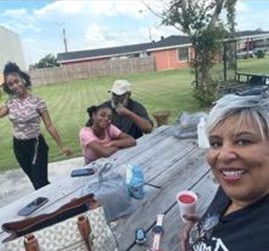
ETC FRC’s Kinship Navigator Program blends emergency assistance, evidence-based parenting education, and peer support for relatives and fictive kin raising children. Services are delivered both at the center and through the mobile outreach team that visits each parish weekly.
Innovation #1: Mobile Outreach Unit
ETC FRC operates a fully staffed mobile FRC that delivers case management, kinship navigation, parenting classes, and emergency supports directly to families. This model removes transportation and awareness barriers for rural families, ensuring no caregiver is left behind.
Innovation #2: Inclusion of Fictive Kin
ETC FRC expands eligibility to include fictive kin—trusted adults like godparents and close family friends—without requiring legal guardianship. As long as they are the primary emotional and caregiving support for the children in their care, they qualify for full services. This model helps children remain safely with caregivers they already know and trust.
At a Glance
- Annual Program Cost: ≈$260,000 (includes $60,000 for emergency concrete supports)
- Full-Time Equivalent (FTE) Staff: 2.5 (2 kinship staff + 0.5 administrative staff, including mobile outreach)
- Duration/Dosage: Stage-based model: weekly → 3x/month → 2x/month → monthly; open re-entry anytime
- Evidence-Based / Research-Based: Nurturing Parenting Program (NPP), Trust-Based Relational Intervention (TBRI)
- Formal Curriculum: NPP, TBRI
- Staff Training Required: Orientation, safe sleep, car seat safety, CarFit, CPR/first aid, resource navigation, NPP, TBRI
Program in Action: A Family Restored
When grandparents raising their grandchildren lost their home in a fire, ETC FRC stepped in immediately, covering hotel costs for the first week, securing funds for a deposit and initial rent for a new apartment, and coordinating with the school and community to gather donations. Even after the family moved into permanent housing, ETC FRC continued to help, replacing an uninsured air conditioning unit and connecting the grandparents to counseling resources.
The result: The children remained safely with their grandparents, avoiding child welfare placement, and the family regained stability.
What They’ve Learned
- Meeting immediate needs first (food, rent, clothing) stabilizes families for long-term success.
- Outreach must be proactive: “We make sure we are where the people are.”
- Cross-training ensures all staff can support any kinship family.
- Tiered engagement levels based on family needs build trust and adapt to family needs over time.
- Blending safety education (safe sleep, car seat, CarFit) with peer support creates a whole-family safety and support model.
Results & Replication
Evaluation
ETC FRC tracks satisfaction surveys, placement stability, and service usage. Results consistently show high family satisfaction; children remain with someone with whom they are familiar and feel safe, and child welfare entry is successfully prevented.
Replication Potential
- A mobile FRC outreach model can be extremely valuable for rural communities.
- Stage-based engagement is adaptable to diverse contexts.
- Blending safety education with peer support can create a holistic model.
This spotlight is part of a national series celebrating innovation in Family Resource Centers serving kinship/grandfamilies. To learn more about how Family Resource Centers support kinship/grandfamilies, see Family Resource Center Services and Supports for Kinship/ Grandfamilies, a resource created by the National Family Support Network and the Grandfamilies & Kinship Support Network.